

Generation
Solar articulation concepts and shadow avoidance assumptions for polar vs equatorial sites.
Aerospace / Lunar Mobility / Human Systems
Lunar terrain vehicle concept exploration aligned with NASA Artemis-era unpressurized surface mobility goals.
A systems-design narrative for how suited crews, autonomous rovers, power infrastructure, and serviceable payloads can operate together on the Moon — structured as a milestone-ready portfolio piece.
Challenge and approach
The Moon demands mobility that survives dust, thermal swings, and communication latency while supporting science, EVA servicing, and autonomous repositioning. The design approach decomposes the LTV into human, vehicle, power, payload, mobility, cable management, navigation, and serviceability systems — then stress-tests interfaces where those domains meet.
Why it matters
Clear system boundaries reduce integration risk when vehicles, power plants, and payloads evolve under milestone-based delivery.
Main feature
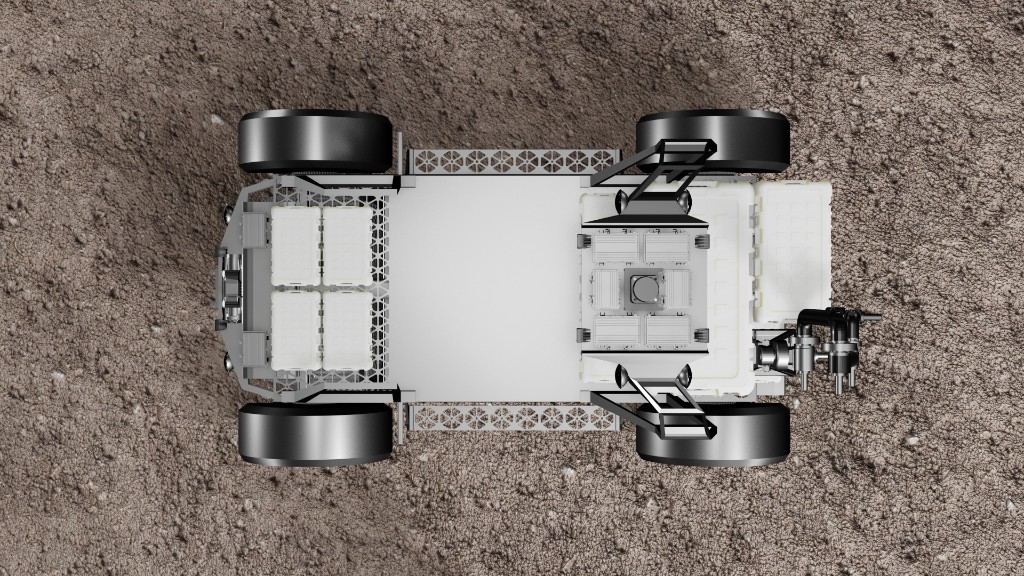
This front, side, rear, and top composition anchors the LTV story as a single systems artifact. It brings stance, wheel package, crew visibility, deck planning, and service geometry into one frame so reviewers can evaluate the entire platform before diving into subsystem detail.
Main four-view system read — primary architecture frame.
Form-finding before hardware language locks
Twelve side-profile explorations trace how the LTV silhouette moves between enclosed pod, open-frame serviceability, and mast-forward sensor posture. White-on-black sketches keep the conversation on proportion, stance, and crew visibility — not surfacing — so the team can compare twelve futures in one glance and decide which geometries earn CAD.
Why it matters
Low-fidelity grids like this collapse weeks of opinion into one wall: stakeholders read silhouette, not part numbers.
Gloved hands, bounded torque, and readable affordances
Nine grayscale controller studies step from T-handle joysticks through ribbed columns to yokes with integrated displays. The progression documents grip diameter, thumb reach, and how much structure can live above the wrist before suited operators lose fine control — the same questions that later inform harness routing and dash sealing.
Five views, one sheet — payload, vision, and structure argued in the open
This board is where industrial design and systems engineering share a wall: front, rear, plan, side, and a perspective read tie lighting, overhead instruments, dual-level payload bays, and frame-integrated fenders into one narrative. Teal callouts are not decoration — they flag interfaces reviewers will later demand in ICDs: where vision mounts, how crew steps up, and how payload volume steals from thermal margins.
Why it matters
Single-sheet ideation keeps ‘pretty render’ and ‘testable interface’ from drifting apart before CAD locks geometry.
Front/side pairs, orthographic discipline, and silhouette read
These studies bracket the same vehicle between quick character reads and four-view rigor: a two-up front and profile for proportion, a lunar-disc side study for stance, and a labeled orthographic grid for payload bay and lighting intent. Together they show how the team held a consistent wheelbase and roll-cage language while pressure-testing ingress and low front panels for terrain visibility.
Top-down wheel paths — where torque lives in the plan view
Three plan-view chassis studies compare how actuation clusters at the corners, mid-span, or centerline of each axle. The cyan highlights are a shared language with ME: they mark candidate motor or hub-actuator volumes before suspension hardpoints freeze, so industrial design doesn’t paint fenders over unserviceable hardware.
LTV actuation configurations — 08.24.21.
0°, 90°, 180° — the same chassis read against craters, not flat-floor studio
Side and head-on studies place the rover on steep regolith: climbing, descending, and side-hilling. The drawings are intentionally spare — they force the team to ask whether lighting, belly clearance, and suit visibility still hold when the horizon tilts, long before dynamics sims arrive.
LTV angle-of-attack definition — 08.10.21.
Artemis surface missions require unpressurized mobility that can extend crew range, carry instruments, and support overnight survival scenarios where the vehicle becomes a temporary life-support island.
Mission context sets the operating assumptions for power budgets, thermal timelines, and comms duty cycles.
Non-pneumatic lattice studies + vehicle context
A 3×3 wheel board compares compliant organic tweels, dense lattice meshes, knobby industrial rims, and turbine-style dust-shedding spokes — the same structural questions CAD answers later, captured as nine silhouettes engineers can circle in a review. Gallery frames show how those ideas sit on the full rover: tread read in side profile and load path hints from the rear deck.
High-level power architecture: generation, storage, distribution, and fault containment.
Solar articulation concepts and shadow avoidance assumptions for polar vs equatorial sites.
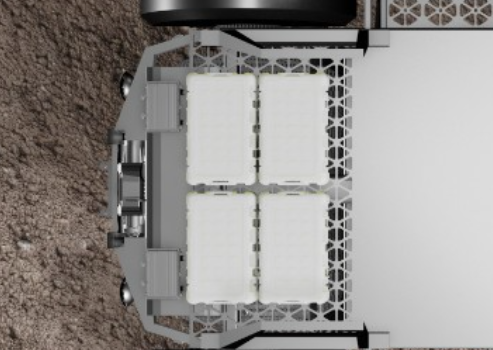
Cell packaging emphasizing thermal runaway isolation and EVA-safe access boundaries.
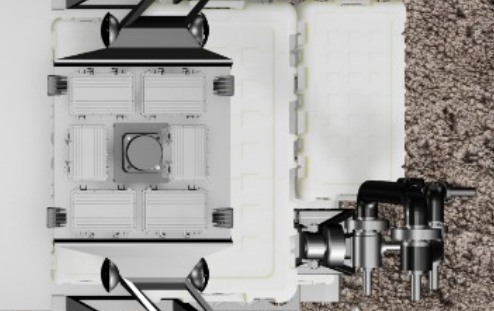
HV/LV segregation, connectorization strategy, and crew-proximate routing rules.
Routing, strain relief, and thermal shadowing for harness bundles exposed to surface thermal cycles.
Instrument swap workflows, contamination control zones, and night parking orientations.
Launch, comms, landers, and rovers in the same story arc
Mobility never exists in isolation: ascent and lander concepts, comms/power towers on the horizon, and robotic precursors set the constraints that an LTV inherits — lighting discipline, branding surfaces that survive vacuum renders, and compositions that read at thumbnail scale. These frames are portfolio-adjacent context: they show the broader lunar surface narrative Volente was designing against, not a single vehicle in a void.
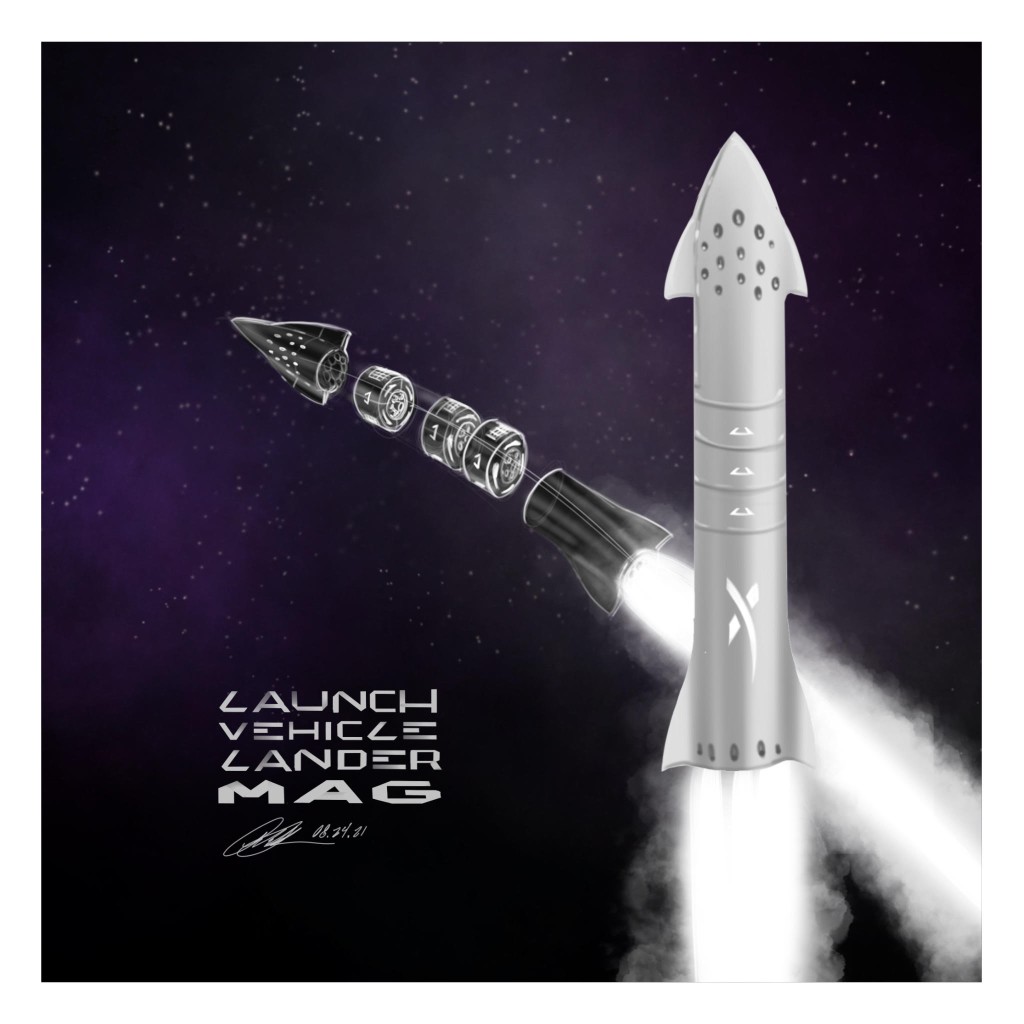
Launch vehicle / lander concept — 08.24.21.
Six keyframes — one vehicle, six reads for review boards and storytelling
After the sketch boards land direction, the 3D set has to prove the same story from every angle reviewers actually use: a wide establishing shot for context, a front three-quarter for identity, isometric for packaging literacy, profile for suited scale, plan view for deck and latch logic, and a rear read for equipment and thermal mass. This mosaic lays those frames out as a single visual system instead of scattering them across the scroll.
A single coherent direction balancing autonomy, serviceability, and crew safety with modular growth.
Early interface control drawings outperformed narrative-only reviews; miniature mission timelines exposed power conflicts faster than static renders; variation comparisons reduced stakeholder disagreement scope.
Lessons tighten the next cycle when hardware partners enter milestone reviews.
Experience
POSE Fitness
A premium, modular case-study architecture that supports visual storytelling, media placeholders, and production-ready editing from Volente Admin.
Experience
Stream Battles
A streamlined, product-first case study built around UI surfaces, interaction flows, and high-clarity competitive states.
Experience
Financial Wellness Credit Card Platform
Narrative case study with six physical card renders, fourteen UI surfaces sequenced by onboarding → dashboard → spend → rewards → wellness → goals → premium, tier pairing sections, architecture diagram, and closing ecosystem collage.
Context: Volente Labs (concept portfolio)
Bring your direction, constraints, and goals. We will map the right pathway and move with you from planning into execution.
Build With Volente